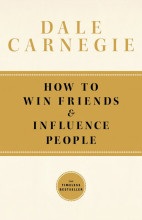
Summary: How To Win Friends And Influence People | 9781451621716 | Dale Carnegie
- This + 400k other summaries
- A unique study and practice tool
- Never study anything twice again
- Get the grades you hope for
- 100% sure, 100% understanding
Read the summary and the most important questions on How To Win Friends and Influence People | 9781451621716 | Dale Carnegie
-
2 The Big Secret Of Dealing With People
This is a preview. There are 1 more flashcards available for chapter 2
Show more cards here -
What is the only one way under high heaven to get anybody to doanything?
By making the other person want to do it. Remember, there is no other way. -
The only way I can get you to do anything is by giving you what youwant. What do you want?
Sigmund Freud said that everything you and I do springs from two
motives: the sex urge and the desire to be great.
John Dewey, one of America's most profound philosophers, phrased
it a bit differently. Dr. Dewey said that the deepest urge in human
nature is "the desire to be important." -
What is the deepest principle in human nature?
Lincoln once began a letter saying: "Everybody likes a compliment."
William James said: "The deepest principle in human nature is the
craving to be appreciated." He didn't speak, mind you, of the "wish"
or the "desire" or the "longing" to be appreciated. He said the
"craving" to be appreciated.
Here is a gnawing and unfaltering human hunger, and the rare
individual who honestly satisfies this heart hunger will hold people in
the palm of his or her hand and "even the undertaker will be sorry
when he dies." -
What is one of the chief distinguishing differences between mankind and the animals?
The desire for a feeling of importance is one of the chief
distinguishing differences between mankind and the animals. -
What does the desire for a feeling of importance lead to?
- poverty-stricken grocery clerk to study some law books - Lincoln
- inspired Dickens to write his immortal novels.
- This desire inspired Sir Christoper Wren to design his symphonies in stone.
- This desire made Rockefeller amass millions that he never spent! -
How did Charles Schwab deal with people?
"I consider my ability to arouse enthusiasm among my people," said
Schwab, "the greatest asset I possess, and the way to develop the
best that is in a person is by appreciation and encouragement.
"There is nothing else that so kills the ambitions of a person as
criticisms from superiors. I never criticize any-one. I believe in giving
a person incentive to work. So I am anxious to praise but loath to
find fault. If I like anything, I am hearty in my approbation and lavish
in my praise. " -
What did Andrew Carnegie write on his tombstone?
Carnegie wanted to praise his assistants even on his tombstone. He
wrote an epitaph for himself which read: "Here lies one who knew
how to get around him men who were cleverer than himself:" -
The difference between appreciation and flattery?
That is simple. One is sincere and the other insincere. One comes from the heart out; the other from the teeth out. One is unselfish; the other selfish.
One is universally admired; the other universally condemned. -
How to appreciate and not flatter?
When we are not engaged in thinking about some definite problem,
we usually spend about 95 percent of our time thinking about
ourselves. Now, if we stop thinking about ourselves for a while and
begin to think of the other person's good points, we won't have to
resort to flattery so cheap and false that it can be spotted almost
before it is out of the mouth. -
3 Part Three - How To Win People To Your Way Of Thinking
-
3.1 You Can't Win An Argument
This is a preview. There are 3 more flashcards available for chapter 3.1
Show more cards here -
How do you end hatred? How do you end a misunderstanding?
Buddha said: "Hatred is never ended by hatred but by love," and a
misunderstanding is never ended by an argument but by tact,
diplomacy, conciliation and a sympathetic desire to see the other
person's viewpoint.
- Higher grades + faster learning
- Never study anything twice
- 100% sure, 100% understanding


For my 1st exam I got a C. Then, I started looking for ways to learn better and I came across Study Smart. Since then I have scored a A+, A, A- and another A. I highly recommend it to everyone who wants to hear it. I am so happy with it!!

I was struggling to finish all my first-year subjects for 3 years. Then I discovered Study Smart, which helped me to finish all of them within 3 months.

Because of StudySmart, things are going well in many ways. Before, I always had study stress and no time for anything. Now I feel calm and confident (because of the program). I used to score a B, now I usually score an A or A+.

Hey Chris, I really want to thank you very much for developing the platform, I usually got around C for my exams, now I scored an A+, an A and a A- !!

Since using Study Smart, my average has increased significantly. I even completed a statistics course with a A+ while I'm bad at statistics. I took on extra courses this year, because of Study Smart. Thanks so much!

Ever since I started studying with StudySmart I passed all my exams !!! No more re-sits!! At first, I was happy with a pass and now I only get good grades. Many thanks!

I aced all the courses I studied with Study Smart. For law, I first scored a D, and now an A! I’m 100% sure that I’ll pass all the courses I study with Study Smart.

I always thought I studied well. My grades were fine. I could never have imagined that applying these study skills would have such a huge and direct impact on my grades, my speed and the pleasure I have in learning.

For the first time, I finally feel totally confident about the way I learn. I have the perfect overview and make great progress in terms of speed and the grades I get. Thanks, Chris!

I immediately started to enjoy learning again, and my grades soared. All of a sudden, everything went better. I highly recommend Study Smart to all students..

Being able to create my materials online made the process of studying so much smoother and quicker. I no longer have to spend a huge amount of my time on creating my summaries.

At first, my notes were a mess. Now I use Study Smart to take my notes in a perfectly structured way. It helps me to save a lot of time and do other things I enjoy.

Students that study with Study Smart get better grades. The system applies all the learning methods in such a way that both well-performing students and students who struggle perform much better.

Hi Chris, I would like to thank you very much. Last year I scored C on a course, and this year I got an A+ thanks to your method! Thank you very much!

The largest effect is that my child is more enthusiastic about school! Every parent wants their children to be happy at school, Study Smart made it happen.

In high school, I failed several exams, and that has really changed now. I actually needed this tool very much back then. Since I started studying with StudySmart, I haven't had any D's. My average score is now an A and those are results I would have never had in the past

With my old method, I passed only 3 out of 8 courses. Since I started taking my notes digitally in Study Smart, I have passed all my courses on the first try. For me, StudySmart takes away the stress of wondering if I will pass or not.

Thanks to StudySmart, I passed all my exams, and with better grades than before! On top of that, I have mastered a very good study method now, which I am confident will help me earn my degree.