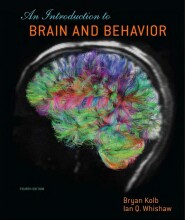
Summary: Introduction To Brain And Behavior | 9781464139604 | Bryan Kolb, et al
- This + 400k other summaries
- A unique study and practice tool
- Never study anything twice again
- Get the grades you hope for
- 100% sure, 100% understanding

Read the summary and the most important questions on Introduction to Brain and Behavior | 9781464139604 | Bryan Kolb; Ian Q. Whishaw
-
1 What are the origins of brain and behavior?
-
1.1 The brain in the twenty-first century
This is a preview. There are 11 more flashcards available for chapter 1.1
Show more cards here -
Minimally conscious state (MCS)
A patient can display rudimentary behaviors but is otherwise unconscious -
Persistent vegetative state (PVS)
A patient is alive but unaware, unable to communicate or function -
2 What is the nervous system's functional anatomy?
This is a preview. There are 1 more flashcards available for chapter 2
Show more cards here -
2.1 Overview of brain function and structure
This is a preview. There are 18 more flashcards available for chapter 2.1
Show more cards here -
Inferior (bird), Ventral (four-legs)
Near the belly -
2.3 The central nervous system: mediating behavior
This is a preview. There are 16 more flashcards available for chapter 2.3
Show more cards here -
Basal ganglia (forebrain)
Voluntary movement of body parts -
Law of Bell and Magendie
Sensory fibers are dorsal/posterior and motor fibres are ventral/anterior -
2.6.1 Principle 1: the nervous system produces movement in a perceptual world the brain constructs
-
Principle 1: The nervous system produces movement in a perceptual world the brain constructs.
Movements are related to sensations, memories and other factors. What we perceive are approximations of what is actually present. -
2.6.2 Principle 2: neuroplasticity is the hallmark of nervous system functioning
-
Principle 2: Neuroplasticity is the hallmark of nervous system functioning.
Experience alter the brain's organization, and this neuroplasticity is needed for learning and memory. Forgetting is presumably due to a loss of the connections that represented the memory. -
2.6.3 Principle 3: many brain circuits are crossed
-
Principle 3: Many brain circuits are crossed.
Most brain inputs and outputs serve the opposite (contralateral) side of the body. Loads of neural connections link the brain's left and right sides, the most prominent connection being the corpus callosum. This principle is not true for olfactory sensation and the SNS, ANS and ENS connections. -
2.6.5 Principle 5: the brain is symmetrical and asymmetrical
-
Principle 5: The brain is symmetrical and asymmetrical.
The left and right hemispheres look like mirror images, but they have some dissimilar features. This asymmetry is essential for integrative tasks, language and body control. For instance, it prevents our hemispheres from both wanting to walk a different way. Language is left, spatial functions are right. -
2.6.6 Principle 6: brain systems are organized hierarchically and in parallel
-
Principle 6: Brain systems are organized hierarchically and in parallel.
Visual information goes from the eyes into regions that detect the simplest properties, then to another region that determines more complex properties until at the most complex level it is understood. But also, one set of pathways process the colour and shape of a car, and at the same time other pathways process movements necessary to open the door.
- Higher grades + faster learning
- Never study anything twice
- 100% sure, 100% understanding


For my 1st exam I got a C. Then, I started looking for ways to learn better and I came across Study Smart. Since then I have scored a A+, A, A- and another A. I highly recommend it to everyone who wants to hear it. I am so happy with it!!

I was struggling to finish all my first-year subjects for 3 years. Then I discovered Study Smart, which helped me to finish all of them within 3 months.

Because of StudySmart, things are going well in many ways. Before, I always had study stress and no time for anything. Now I feel calm and confident (because of the program). I used to score a B, now I usually score an A or A+.

Hey Chris, I really want to thank you very much for developing the platform, I usually got around C for my exams, now I scored an A+, an A and a A- !!

Since using Study Smart, my average has increased significantly. I even completed a statistics course with a A+ while I'm bad at statistics. I took on extra courses this year, because of Study Smart. Thanks so much!

Ever since I started studying with StudySmart I passed all my exams !!! No more re-sits!! At first, I was happy with a pass and now I only get good grades. Many thanks!

I aced all the courses I studied with Study Smart. For law, I first scored a D, and now an A! I’m 100% sure that I’ll pass all the courses I study with Study Smart.

I always thought I studied well. My grades were fine. I could never have imagined that applying these study skills would have such a huge and direct impact on my grades, my speed and the pleasure I have in learning.

For the first time, I finally feel totally confident about the way I learn. I have the perfect overview and make great progress in terms of speed and the grades I get. Thanks, Chris!

I immediately started to enjoy learning again, and my grades soared. All of a sudden, everything went better. I highly recommend Study Smart to all students..

Being able to create my materials online made the process of studying so much smoother and quicker. I no longer have to spend a huge amount of my time on creating my summaries.

At first, my notes were a mess. Now I use Study Smart to take my notes in a perfectly structured way. It helps me to save a lot of time and do other things I enjoy.

Students that study with Study Smart get better grades. The system applies all the learning methods in such a way that both well-performing students and students who struggle perform much better.

Hi Chris, I would like to thank you very much. Last year I scored C on a course, and this year I got an A+ thanks to your method! Thank you very much!

The largest effect is that my child is more enthusiastic about school! Every parent wants their children to be happy at school, Study Smart made it happen.

In high school, I failed several exams, and that has really changed now. I actually needed this tool very much back then. Since I started studying with StudySmart, I haven't had any D's. My average score is now an A and those are results I would have never had in the past

With my old method, I passed only 3 out of 8 courses. Since I started taking my notes digitally in Study Smart, I have passed all my courses on the first try. For me, StudySmart takes away the stress of wondering if I will pass or not.

Thanks to StudySmart, I passed all my exams, and with better grades than before! On top of that, I have mastered a very good study method now, which I am confident will help me earn my degree.
Topics related to Summary: Introduction To Brain And Behavior
-
What is the nervous system's functional anatomy? - Ten principles of nervous system function
-
How do we study the brain structures and functions?
-
How do we sense, perceive and see the world? - The visual system's functional anatomy - Types of retinal neurons
-
How do we hear, speak and make music? - Sound waves: stimulus for audition - Physical properties of sound waves
-
How does the nervous system respond to stimulation and produce movement? - Somatosensory system receptors and pathways