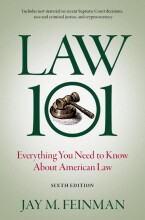
Summary: Law 101 Everything You Need To Know About American Law | 9780197662571 | Jay M Feinman
- This + 400k other summaries
- A unique study and practice tool
- Never study anything twice again
- Get the grades you hope for
- 100% sure, 100% understanding

Read the summary and the most important questions on Law 101 Everything You Need to Know about American Law | 9780197662571 | Jay M. Feinman
-
1 There Are No Secret Books
-
What are some notable cases that illustrate the complexities of the law in America?
American law is illustrated by various notable cases:- Ahmaud Arbery - debated self-defense in confrontations.
- Stella Liebeck - discussed torts relating to personal injuries from hot coffee.
- James Obergefell - explored constitutional rights for same-sex marriage.
-
How is the first year of law school structured in American law schools?
The first-year curriculum typically covers fundamental topics:- Constitutional Law - structure of government and personal liberties (Chapters 2 & 3).
- Civil Procedure - process of litigation (Chapter 4).
- Tort Law - personal injuries and liabilities (Chapter 5).
- Contract Law - private agreements (Chapter 6).
- Property Law - ownership relationships (Chapter 7).
- Criminal Law - wrongful conduct penalties (Chapter 8).
- Criminal Procedure - processes and rights for defendants (Chapter 9).
-
What is a common misconception about the law?
Many believe that law exists solely in books. However:- Law resides in conduct - it is demonstrated through actions of judges, lawyers, and citizens.
- Practical examples - everyday examples, like speed limits, reflect real-life practices that deviate from written laws.
- Understanding law relies on examining real-world events rather than solely theoretical texts.
-
Why is law considered a battleground of political conflict?
Legal questions often reflect political controversies:- Fundamental issues - such as who gets what, life and death matters, and what is right or wrong.
- Constitutional examples - ongoing debates like abortion rights illustrate political struggles.
- Contextual relevance - other legal matters, like liability in the opioid crisis, also carry political significance.
-
How does this book aim to make the law more accessible?
The book intends to demystify law with the following approaches:- Simplification - explaining fundamental legal concepts and rules.
- Engagement - presenting law through puzzles and thought-provoking scenarios.
- Contextual exploration - covering big legal issues rather than procedural mechanics, making it relevant to everyone.
-
Why are Americans fascinated by the law?
Interest in the law stems from its importance and intellectual challenges. Key points include:- Legal cases can be dramatic and newsworthy.
- Topics like self-defense, torts, and constitutional rights are significant.
- Law impacts daily life through regulations and public conduct.
- The law is complex, prompting a desire for more understanding.
-
What are the fundamental topics studied in most American law schools?
Almost every law school's curriculum discusses these core subjects:- Constitutional law - structure and personal liberties.
- Civil procedure - litigation processes.
- Tort law - personal injuries.
- Contract law - agreements.
- Property law - ownership relations.
- Criminal law - wrongful conduct.
- Criminal procedure - rights of defendants.
-
How does the law reflect the complexities of life?
Law mirrors life's complexities in various ways:- Legal issues often lack simple solutions.
- Exceptions arise, complicating clear rules.
- Legal and personal beliefs may conflict.
- Legal decisions often involve political dimensions.
- The law must adapt to societal values and ethics.
-
What is the purpose of Law 101 according to the text?
Law 101 aims to provide foundational legal knowledge for everyone by:- Explaining the basics of law, rules, and arguments.
- Using relevant legal cases to illustrate principles.
- Making complex ideas accessible.
- Engaging readers with interesting and thought-provoking content.
- Allowing participation in legal discussions after understanding core concepts.
-
2 The Supreme Law of the Land
This is a preview. There are 3 more flashcards available for chapter 2
Show more cards here -
What are the basic elements of constitutional law that many people recall?
Basic elements of constitutional law include:- Separation of powers
- Judicial review
- Due process
- Equal protection of law
- Freedom of speech, religion, and press
- Higher grades + faster learning
- Never study anything twice
- 100% sure, 100% understanding


For my 1st exam I got a C. Then, I started looking for ways to learn better and I came across Study Smart. Since then I have scored a A+, A, A- and another A. I highly recommend it to everyone who wants to hear it. I am so happy with it!!

I was struggling to finish all my first-year subjects for 3 years. Then I discovered Study Smart, which helped me to finish all of them within 3 months.

Because of StudySmart, things are going well in many ways. Before, I always had study stress and no time for anything. Now I feel calm and confident (because of the program). I used to score a B, now I usually score an A or A+.

Hey Chris, I really want to thank you very much for developing the platform, I usually got around C for my exams, now I scored an A+, an A and a A- !!

Since using Study Smart, my average has increased significantly. I even completed a statistics course with a A+ while I'm bad at statistics. I took on extra courses this year, because of Study Smart. Thanks so much!

Ever since I started studying with StudySmart I passed all my exams !!! No more re-sits!! At first, I was happy with a pass and now I only get good grades. Many thanks!

I aced all the courses I studied with Study Smart. For law, I first scored a D, and now an A! I’m 100% sure that I’ll pass all the courses I study with Study Smart.

I always thought I studied well. My grades were fine. I could never have imagined that applying these study skills would have such a huge and direct impact on my grades, my speed and the pleasure I have in learning.

For the first time, I finally feel totally confident about the way I learn. I have the perfect overview and make great progress in terms of speed and the grades I get. Thanks, Chris!

I immediately started to enjoy learning again, and my grades soared. All of a sudden, everything went better. I highly recommend Study Smart to all students..

Being able to create my materials online made the process of studying so much smoother and quicker. I no longer have to spend a huge amount of my time on creating my summaries.

At first, my notes were a mess. Now I use Study Smart to take my notes in a perfectly structured way. It helps me to save a lot of time and do other things I enjoy.

Students that study with Study Smart get better grades. The system applies all the learning methods in such a way that both well-performing students and students who struggle perform much better.

Hi Chris, I would like to thank you very much. Last year I scored C on a course, and this year I got an A+ thanks to your method! Thank you very much!

The largest effect is that my child is more enthusiastic about school! Every parent wants their children to be happy at school, Study Smart made it happen.

In high school, I failed several exams, and that has really changed now. I actually needed this tool very much back then. Since I started studying with StudySmart, I haven't had any D's. My average score is now an A and those are results I would have never had in the past

With my old method, I passed only 3 out of 8 courses. Since I started taking my notes digitally in Study Smart, I have passed all my courses on the first try. For me, StudySmart takes away the stress of wondering if I will pass or not.

Thanks to StudySmart, I passed all my exams, and with better grades than before! On top of that, I have mastered a very good study method now, which I am confident will help me earn my degree.
Topics related to Summary: Law 101 Everything You Need To Know About American Law
-
There Are No Secret Books
-
The Supreme Law of the Land - WHAT IS CONSTITUTIONAL LAW?
-
The Supreme Law of the Land - WHY DO WE NEED CONSTITUTIONAL LAW?
-
The Supreme Law of the Land - HOW DOES THE SUPREME COURT DECIDE WHAT THE CONSTITUTION MEANS?
-
The Supreme Law of the Land - WHERE DOES THE SUPREME COURT GET THE AUTHORITY TO INTERPRET THE CONSTITUTION?
-
The Supreme Law of the Land - WHAT POWERS DO THE STATES HAVE UNDER CONSTITUTIONAL LAW?
-
First Freedoms Constitutional Rights - WHAT RIGHTS DOES CONSTITUTIONAL LAW PROTECT?
-
First Freedoms Constitutional Rights - WHAT IS DUE PROCESS?