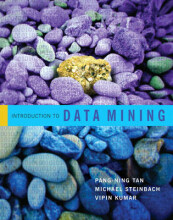
Summary: Introduction To Data Mining | 9780321321367 | Pang Ning Tan, et al
- This + 400k other summaries
- A unique study and practice tool
- Never study anything twice again
- Get the grades you hope for
- 100% sure, 100% understanding
Read the summary and the most important questions on Introduction to data mining | 9780321321367 | Pang-Ning Tan ; Michael Steinbach ; Vipin Kumar.
-
1 Introduction
This is a preview. There are 8 more flashcards available for chapter 1
Show more cards here -
The Data Miner's Toolkit can be broken down into two fundamental tasks. Which two tasks are we talking about?
Predictive Tasks.- Goal: Predict the future.
- Use known data to predict unknown values.
- E.g., Will this customer spend more than $100 today?
- Common tasks:
- Classification.
- Regression.
- Deviation/Anomaly Detection.
Descriptive Tasks.- Goal: Understand the present.
- Finds human-interpretable patterns.
- Requires post processing to validate & explain results.
- E.g., What are our main customer groups, what have our best customers in common?
- Common Tasks:
- Clustering.
- Association Rule Discovery.
- Sequential Pattern Discovery.
-
What is (one of) the most famous discoveries made by data mining?
- Men who bought diapers on a Friday night were also likely to buy beer.
- Highlights Data Mining's power to discover surprising, non-obvious and useful patterns.
- Men who bought diapers on a Friday night were also likely to buy beer.
-
Deviation/Anomaly Detection is a predictive task of data mining. Can you explain what it is?
- Identify abnormal behaviour.
- By training the model on what is "normal" behaviour, it can predict more accurate which data points, patterns, or events are very different, or anomalous, from the "normal behaviour.
- These cases are called anomalies, outliers, or deviations.
- By identifying them, we can detect problems, risks, or are but important events.
Common Applications:- Credit Card Fraud Detection (which transactions are anomalies and potentially fraudulent?).
- Network Intrusion Detection (Detect unusual patterns in network traffic that might indicate an intrusion).
- Identifying Disease and ecosystem disturbances.
- Identify abnormal behaviour.
-
2 Data
This is a preview. There are 17 more flashcards available for chapter 2
Show more cards here -
What is data preprocessing and what are the seven key preprocessing techniques?
- Data Preprocessing.
- Making raw data more suitable for data mining analysis.
- Involves: Improving data quality, adapting data for specific algorithms, improving algorithm performance.
- Seven key preprocessing techniques:
- Aggregation.
- Sampling.
Dimensionality Reduction .- Feature subset selection.
- Feature Creation.
- Discretisation and Binarisation.
- Attribute Transformation.
- Data Preprocessing.
-
Can you describe the preprocessing technique called Aggregation?
- Combining two or more attributes/objects into a single attribute/object.
- Pros:
- Reduces data size.
- Changes the scale by providing a higher-level view.
- Makes data more stable (i.e., less variability for aggregate quantities like averages).
- Cons:
- Potential loss of interesting details.
- E.g., taking daily sales figures and aggregating them into monthly/yearly totals.
-
What are the best ways for Dimensionality Reduction?
- Linear Algebra Techniques.
- Components Analysis (PCA).
- Singular Value Decomposition.
- Feature Subset Selection.
- Linear Algebra Techniques.
-
Similarity and Dissimilarity are both proximity measures. Can you explain how they differ form each other?
- Similarity.
- Numerical measure showing how alike two data objects are.
- The more alike, the higher.
- Often a range of [0, 1].
- Dissimilarity.
- Numerical measure showing how different two data objects are.
- The more different, the higher.
- Minimum dissimilarity is often 0, but the upper limit varies.
- Similarity.
-
Similarity measures, like the Jaccard similarity measure, have two of the same properties a metric (distance) has. What two properties are they, and why doesn't the other property apply?
- Properties in common:
- Positivity (non-negativity).
- Symmetry.
- Similarity doesn't have the triangle inequality.
- Similarity doesn't measure "length" or "shortest path.
- Similarity measures overlap, resemblance, or angle.
- A can overlap B, and B can overlap C, but A and C might share practically nothing in common.
- This would break the triangle inequality.
- Properties in common:
-
Like cosine Similarity, the extended Jaccard Coefficient is also a vector-based similarity measure. When would you use the Extended Jaccard Coefficient over the Cosine Similarity?
- Absolute quantities.
- When besides the proportions (do both customers have product X in their basket), quantity matters too (Customer A has bought 3 apples, Customer B has bought 8 apples.
- Absolute quantities.
-
What is the Extended Jaccard Coefficient (Tanimoto Coefficient) and how does it differ from the normal one?
- Non-binary attributes.
- The normal Jaccard coefficient only works with binary attributes (absence (0) vs presence (1)).
- The Extended Jaccard Coefficient can be used for all positive numbers.
- Non-binary attributes.
- Higher grades + faster learning
- Never study anything twice
- 100% sure, 100% understanding


For my 1st exam I got a C. Then, I started looking for ways to learn better and I came across Study Smart. Since then I have scored a A+, A, A- and another A. I highly recommend it to everyone who wants to hear it. I am so happy with it!!

I was struggling to finish all my first-year subjects for 3 years. Then I discovered Study Smart, which helped me to finish all of them within 3 months.

Because of StudySmart, things are going well in many ways. Before, I always had study stress and no time for anything. Now I feel calm and confident (because of the program). I used to score a B, now I usually score an A or A+.

Hey Chris, I really want to thank you very much for developing the platform, I usually got around C for my exams, now I scored an A+, an A and a A- !!

Since using Study Smart, my average has increased significantly. I even completed a statistics course with a A+ while I'm bad at statistics. I took on extra courses this year, because of Study Smart. Thanks so much!

Ever since I started studying with StudySmart I passed all my exams !!! No more re-sits!! At first, I was happy with a pass and now I only get good grades. Many thanks!

I aced all the courses I studied with Study Smart. For law, I first scored a D, and now an A! I’m 100% sure that I’ll pass all the courses I study with Study Smart.

I always thought I studied well. My grades were fine. I could never have imagined that applying these study skills would have such a huge and direct impact on my grades, my speed and the pleasure I have in learning.

For the first time, I finally feel totally confident about the way I learn. I have the perfect overview and make great progress in terms of speed and the grades I get. Thanks, Chris!

I immediately started to enjoy learning again, and my grades soared. All of a sudden, everything went better. I highly recommend Study Smart to all students..

Being able to create my materials online made the process of studying so much smoother and quicker. I no longer have to spend a huge amount of my time on creating my summaries.

At first, my notes were a mess. Now I use Study Smart to take my notes in a perfectly structured way. It helps me to save a lot of time and do other things I enjoy.

Students that study with Study Smart get better grades. The system applies all the learning methods in such a way that both well-performing students and students who struggle perform much better.

Hi Chris, I would like to thank you very much. Last year I scored C on a course, and this year I got an A+ thanks to your method! Thank you very much!

The largest effect is that my child is more enthusiastic about school! Every parent wants their children to be happy at school, Study Smart made it happen.

In high school, I failed several exams, and that has really changed now. I actually needed this tool very much back then. Since I started studying with StudySmart, I haven't had any D's. My average score is now an A and those are results I would have never had in the past

With my old method, I passed only 3 out of 8 courses. Since I started taking my notes digitally in Study Smart, I have passed all my courses on the first try. For me, StudySmart takes away the stress of wondering if I will pass or not.

Thanks to StudySmart, I passed all my exams, and with better grades than before! On top of that, I have mastered a very good study method now, which I am confident will help me earn my degree.